What Impact Did This Have on Christian Art in the Predominantly Catholic Areas of Europe Like Italy?
The church building and the Baroque
The Baroque style flourished thank you to the patronage of the Roman Catholic Church building. Promoted by generations of popes, cardinals, priests, missionaries and worshippers, the fashion spread around the world.
Baroque religious art was not only visible in churches, information technology was also seen on street corners and squares, on shrines and public statues as well equally existence carried in processions. Although the Baroque fashion was closely associated with the ability and authority of the Cosmic church, information technology would also have been familiar to many Protestants.
Baroque employed painting, sculpture, architecture and the decorative arts forth with music and verse to entreatment to all of the senses. Seeking a combined event, these 'total works of art' were intended both to print and move their viewer. Bizarre religious objects not but inspired devotion, they too brought honour to those who commissioned them as well as the craftsmen and artists who created them.
Rome and the papacy
Bizarre Rome was the headquarters of the Roman Catholic church. Like princes, the popes used their patronage to wield power. They spent vast sums on edifice projects, art commissions and establishing collections. Some popes set creative trends past favouring detail artists, art media and subjects. Gianlorenzo Bernini (1598 – 1680) worked for a succession of popes and was known particularly for his uniting of sculpture, painting and architecture in works such as the Cornaro Chapel and in his designs for St Peter's Basilica in Rome.
The 5&A's drove includes two busts by the Italian sculptor Domenico Guidi representing Pope Innocent X (reigned 1644 – 55) and Pope Alexander VIII (reigned 1689 – 91). The sweeping vestments and Baroque naturalism give the portrait busts immense presence and power. Papal busts of this blazon were regularly made in the Vatican's foundry.

Within the Baroque church
On entering a Baroque church, the worshipper met with a space of dramatic intensity that expressed the triumph of the Catholic Church. A vast array of materials were used for decoration: statuary railings and lighting, silver ceremonial objects, and carved and decorated wood for seating and framing pictures. Almost all surfaces were painted or gilded, embroidered textiles were used as hangings, vestments and covers, and sculptures of woods, rock, metal, clay or plaster were assail and around the altars.
Many spaces inside the church building were turned over to commemorative utilize. The popes and their families competed with each another to secure prestigious burial places in the well-nigh important churches in Rome and to erect impressive funeral monuments.
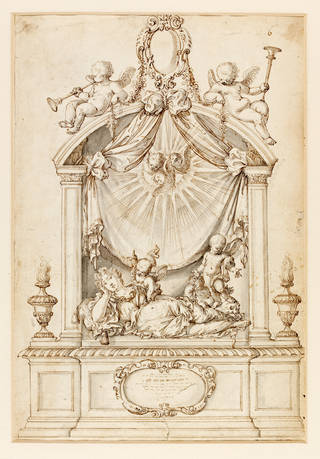
The elaborate nature of funerary monuments is shown past a design in our collection for a monument to commemorate Lady Dorothy Brownlow (1665 –99/1700), married woman of Sir William Brownlow. Situated in the English church of St Nicholas, Sutton, the monument is described past John Aubrey in his The Natural History and Antiquities of the County of Surrey (1718) as a:
"cute Marble Monument railed in, whereon lies, at total length, a Lady leaning on her left Arm, and by her three Children, ii weeping, and one pointing to a Celebrity surrounded with Cherubims on a Curtain, on the Meridian two Cupids with Golden Trumpets; on each side 2 Urns"
An inscription on the monument establishes Lady Brownlow'south lineage. Social elites used such monuments to reinforce their social ranking.
The performance of the Mass
Performance was as prominent in the sacred spaces of chapels and churches every bit it was in the theatre. During Mass – performed to commemorate Christ'due south sacrifice on the cross – Catholics believe the 'Host' (a minor, flat wafer symbolising the breadstuff of the Last Supper) and the wine miraculously get the trunk and claret of Christ. In typical Baroque fashion, the 'Host' would have been displayed to the congregation past placing it in the central window (the 'lunula'), of a highly decorative object called a monstrance. The monstrance would have been placed on the chantry as a focus for worship, or held up during church processions for the congregation to see.
This example in our collection was made by Johann Zeckel, who was ane of the leading goldsmiths of the time in Augsburg, Bavaria. It is elaborately decorated with imagery associated with Christ. The plaque below the key window shows the Last Supper, in which Christ shared bread and wine with his disciples, saying, "This is my body and claret". The cornucopias – horns on either side of the monstrance – contain grapevines and ears of corn and symbolise the wine and breadstuff of the service. Every bit the altar was central to this ritual, they were often given considerable attention from patrons and artists, such equally the statuary 'baldachin' or canopy, that Bernini designed for the altar of St. Peter'south Basilica in Rome.

The significance of saints
Within the Cosmic Church, saints were seen as of import part models whose actions could educate and inspire. Newly created saints, who had been missionaries, were specially of import. Within churches, holy vessels were produced to tell their story and to protect and brandish bodily relics. Another pop motif was the Virgin Mary. Baroque artists developed different images of Mary, in the role of female parent, sis or daughter. 1 of her most pop 17th-century personifications was 'Virgin of Sorrows', where she was depicted anguished, suffering and lonely. Busts of the sorrowful Virgin were often placed in the side chapels of churches as a focus for private devotion, maybe alongside a similar bust of Christ displaying his wounds. Our collection includes a Castilian bust of the 'Virgin of Sorrows' ingeniously synthetic from ivory, glass and painted pinewood to await as lifelike equally possible. While some of the sculpture's original color has been lost – traces of tears might well have once been visible on the cheeks – its uncomplicated power is nonetheless intact. The bust exemplifies how artists could convey intense emotion through apparently plain, naturalistic forms. Its realistic appearance would have encouraged worshippers to imagine the Virgin'due south sorrow at her son's suffering as their ain.

Religious ceremony outside the church
Religious devotion did non but take place in church. Only as processions were used for secular displays of power, the Church building used them for meaning religious occasions, such equally to mark Holy Week or saints' days, where carved and painted wooden sculptures were carried through the streets.
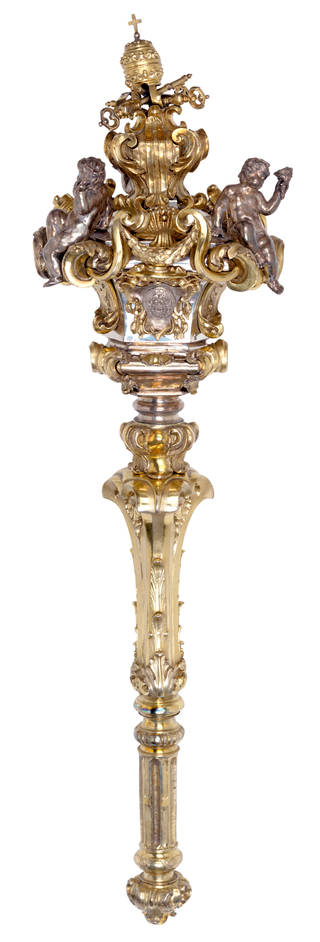
Our drove includes a ceremonial mace, or ornamental staff, made for a key on his engagement to symbolise his authorisation. A special bearer would have carried information technology during ceremonial processions and it is designed to impress, weighing most 10 kilograms. The mace would originally have included the coat of arms of the central who endemic it and of the pope who appointed him. Such maces were often re-used, with the artillery inverse to reflect their new ownership. This mace includes a shield with the name of Pope Pius VII, who consecrated Napoleon I as Emperor at Paris in 1804, and the arms of Cardinal Oppizzoni, who took a prominent function in Napoleon's coronation as Male monarch of Italian republic at Milan in 1805. It'due south believed that it was used on both those occasions.
Private devotion
Christians of all denominations were encouraged to engage in spiritual improvement and renewal. Many devotional exercises were undertaken in private and were facilitated by images and other works of art, which could include everything from simple wooden crosses to costly bejewelled treasures.
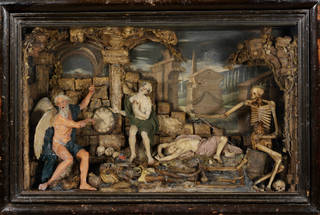
A macabre wax relief tableau of Fourth dimension and Death in our drove was created to remind the viewer of the transience of life and worldly glory. The scene depicts the winged figure of Father Time and a crowned skeleton representing Death, surrounded by discoloured and decaying corpses in a crumbling graveyard. While wax was widely used in Naples for sculpting minor-scale Nativity scenes, only a handful of these 'petty theatres of death' are known to accept survived. Caterina de Julianis, a Neapolitan nun who specialised in wax modelling – an ideal medium for such morbid subject matter – probably made this macabre depiction. It shows how much sacred fine art was part of everyday life, rather than only beingness confined to the spaces of the church.

Background image: The Virgin of Sorrows, José de Mora, about 1680 – 1700, Spain. Museum no. 1284-1871. © Victoria and Albert Museum, London
Source: https://www.vam.ac.uk/articles/the-church-and-the-baroque
0 Response to "What Impact Did This Have on Christian Art in the Predominantly Catholic Areas of Europe Like Italy?"
Postar um comentário